Remaining human in the age of algorithms
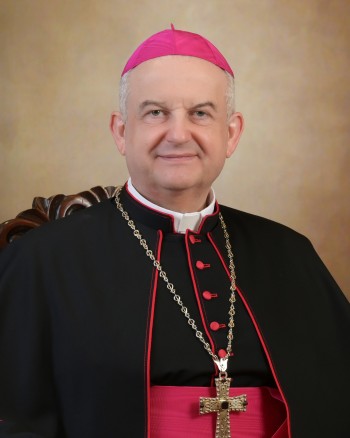
A reflection on Pope Leo XIV's first encyclical, Magnifica Humanitas, by Archbishop Gábor Pintér, the Apostolic Nuncio to New Zealand
In his newly published encyclical Magnifica Humanitas, Pope Leo XIV calls on us not to pay for technological progress with the impoverishment of the human heart.
In the age of artificial intelligence – when immense concentrations of technological power beyond all control, along with new forms of dehumanisation, are already threatening human dignity – the Holy Father calls us to the “urgent duty” of remaining deeply human. In an era of polarisation and violence, when the “culture of power” is spreading and war is once again becoming accepted as an instrument of international politics, the Successor of Peter asks us to develop technology “without allowing our hearts to lag behind”.
He invites us to accept the limits and fragility of humanity without regarding them – as technocratic ideology does – as defects to be corrected. He urges us not to look at the world from the perspective of the powerful, but from below, through the eyes of those who suffer, beginning with the least among us. Through the eyes of a God who took upon Himself our weakness and transformed it into a place of salvation, because “even when machines excel in efficiency, at the centre of history there still stands a human face waiting to be seen”.
Magnifica Humanitas is not primarily an analytical text about artificial intelligence, nor does it dwell on the details of constantly evolving processes. Rather, it is a “synthetic document” that applies the principles of Catholic social teaching to our age – the age of artificial intelligence – while reaffirming and updating the fundamental points of the Church’s magisterium. The text also dispels misunderstandings among those who, trusting in the absolute freedom of markets and new technologies, tend to dismiss papal teachings advocating the shared and humane governance of AI, integral ecology, new economic structures and the rejection of war as debatable opinions.
The Pope, who chose the name of the author of Rerum Novarum, calls on all of us in the era of the digital revolution to take an active role, because the building of the “civilisation of love” is achieved through “a multitude of small yet steadfast acts of fidelity” capable of restraining dehumanisation. This is therefore a task that concerns each of us directly.
Pope Leo reminds us that “injustices do not arise solely from the wrong decisions of individuals, but also from structures, mechanisms, and economic and cultural systems that generate inequalities”, and that “development cannot be considered truly human if it increases the consumption of some while shifting the costs and burdens onto others, or relegating entire regions to subordinate roles”, as unfortunately is happening today in the field of new technologies and the resources required for them.
The encyclical states that the social function of private property is “certain teaching” of the Church, and that today, among the goods destined for all, “we must also take into account new forms of property: patents, algorithms, digital platforms, technological infrastructures and data”, in order to prevent the emergence or strengthening of new forms of exclusion and deprivation of freedom. Technology, in fact, is not a neutral instrument – and when it becomes a criterion in itself, it “ends up deciding what counts and what may be discarded”, reducing “human beings to cogs in an increasingly efficient system”.
Today, control over platforms, infrastructure, data and computational capacity “is no longer the privilege of states, but of major economic and technological actors” who determine the conditions of access, the rules of visibility and even the very possibility of participation. When such power is concentrated in a few hands, it “tends to become opaque and escape public oversight”, bringing with it the risk of distorted development “that creates new dependencies, exclusions, manipulations, and inequalities”.
The Pope, reaffirming the need to move beyond the theory of the “just war”, calls for the use of artificial intelligence in warfare to be subjected to the strictest ethical limits, because “there is no algorithm capable of making war morally acceptable”. Furthermore, through the manipulation of images and content, AI has become a key factor in shaping public opinion, making it increasingly difficult to distinguish truth from falsehood.
The labour market, too, is surrounded by profound uncertainty. In this regard, the encyclical reminds us that we can no longer rely solely on the “invisible hand” of the market; it is the task of politics to direct economic and technological dynamics toward the common good, promoting dignified work, social inclusion and the fair distribution of the benefits of innovation.
Preserving our humanity, governing processes and preventing monopolies – even in this field – that ultimately increase the power of a few at the expense of the lives of many, the path indicated by the Pope, does not erect barricades, nor does it reject the use of artificial intelligence outright. On the contrary, it highlights its many positive aspects and useful applications, while also explaining that it is not enough merely to ask ethical questions about whether its use serves good or bad purposes.
Early intervention is essential, as is questioning how a system is designed and what vision of the human person and society is embedded in the data and models that govern it. This requires appropriate legal frameworks, independent oversight, user education and, above all, once again, “a politics that does not renounce its responsibilities”. Otherwise, change will be driven solely by technocratic logic and presented as “necessary and inevitable”, ultimately leading to rules dictated by those who possess the data, infrastructure and computational power.
This is why the “disarmament” of artificial intelligence is necessary, that is, “the elimination of the equivalence between technical power and the right to govern” – not in order to renounce technology, but to prevent it from dominating human beings. It must be made open to debate, challenge and, therefore, be inhabitable – precisely so that we do not renounce our humanity, so fragile and yet so “magnificent”.